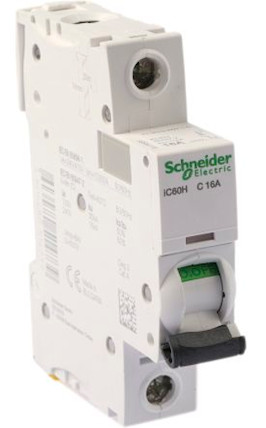
The miniature circuit breaker (MCB) has been the basic level of domestic electrical circuit protection for many years now. Originally used to replace rewireable and cartridge fuses, the MCB is essentially a mechanical, resettable fuse.
Offering convenience from a switch to operate if the device trips or to use for maintenance – to replace a light fitting, for example. No risk of replacing the incorrect size fuse wire, leading to a fire risk as with rewireable fuses. These devices are still in common use, and the modern version complying with BS 60898 is widely fitted today.
Need a consumer unit replacement quote?
Compare quotes from qualified electricians →
When installing a new circuit, rewiring a property or replacing a consumer unit, circuit protection provided by MCB alone is no longer adequate. In fact, almost all electrical accessories – light fittings, towel radiators, outdoor sockets, etc require RCD protection to comply with the manufacturer’s instructions.
Changes in the regulations have resulted in the standard set up for a domestic consumer unit being what is known as the ‘dual RCD’ configuration – see below:
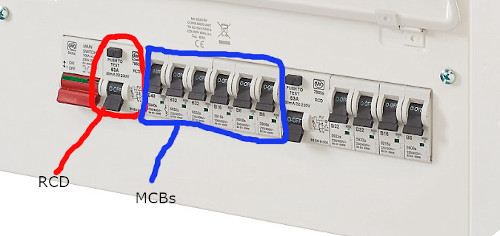
Dual RCD consumer units have been the default configuration for the last 10-15 years. Each individual circuit is provided with short-circuit and overcurrent protection by the MCB and a group of 3-6 MCBs is jointly offered additional electric shock protection by an RCD. Two RCDs are typically used (hence the dual RCD name) with two sets of circuits.
As more advanced forms of protection have been developed, the MCB is still used, but must now be used in conjunction with other devices – the limits of its effectiveness are starting to show in comparison with the RCBO.
Need a consumer unit replacement quote?